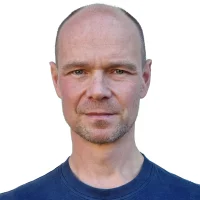
At school I was always the last one picked for any team. I was an overweight kid in 1980s Poland, and I could not run a few hundred metres without stopping.
I believed what that told me. Some people are sporty. I was not.
Today I am 50, and the fittest I have ever been. I run 10K two or three times a week. I swim, lift heavy, and practise yoga and kung fu. I have never felt better in my life. The kid picked last for every team had a ceiling. It was just far higher than he, or anyone around him, believed. I am convinced the same is true for almost everyone, at work and in life.
The ceiling I was handed
Every team sport in PE went the same way. The teams filled up, one name at a time, and I was the one left. The lesson was clear enough, and I learned it well.
A ceiling like that rarely arrives as a single verdict. It builds up from small signals, repeated until they stop feeling like opinions and start feeling like facts about who you are. I was not sporty. I was not strong. Running was something other people did.
Communist Poland added a ceiling of its own. You grew up knowing that the interesting things in the world, the products, the companies, the opportunities, were made somewhere else, by other people. Ambition had a fixed width.
I carried that belief about my body for decades. It never occurred to me to test it, because you do not test facts. You live inside them.
Scared, yet determined
At 43, three discs in my lower back gave way, one of them ruptured. The pain was agonising, day and night, and my foot stopped working. I was offered surgery on the NHS.
I was scared. I was also determined. I decided to fix it through exercise instead.
It took two years. Slow, daily, unglamorous work, most of it at first just learning to move without pain again. Then walking properly. Then, for the first time in my life, running. Then running further. Swimming, lifting, yoga, kung fu followed, each one something I would once have filed under "not for people like me".
The worst moment of my physical life became the start of the best part of it. I had to rebuild from the floor up, and in doing so I found out that the floor was never where the ceiling was.
A necessary word of caution: this was my path, chosen for my injury. It is not a prescription. If you have a spinal injury, follow the advice of your own medical team. The point is not that surgery is wrong. The point is that what I believed about my limits was wrong.
It was never only me
I am not unusual. I grew up in a country with a ceiling built into it, and so did a whole generation.
In 1983, under martial law, a pharmacist called Irena Eris opened a private cosmetics lab with a single cream, because she could not afford a second. State shops refused to stock goods from a private trader. Two years later, a biology student in Poznań called Piotr Woźniak invented computerised spaced repetition on paper, because he did not own a computer. "Even my own family was dismissive," he wrote. The scheduling algorithm in Anki, the flashcard app used by students everywhere, is built on his work.
In the early 1990s, two Warsaw school friends sold computer games at a weekend market. They went on to found CD Projekt, and The Witcher 3 has sold more than 60 million copies.
Then came the next generation. Wojciech Zaremba, an OpenAI co-founder, grew up in Kluczbork, a small town in Opole province. OpenAI's chief scientist, Jakub Pachocki, was taught by a maths teacher at a state school in Gdynia. In 2023, Sam Altman told a Warsaw audience: "I don't know what Poland does as a culture and a system to create such incredible engineering and research talent and also such rigor, which has been, I think, very important to OpenAI's success, but it's quite remarkable the impact that it's had" (Polskie Radio, 2023).
Paweł Marchewka, who founded the games studio Techland, put it best: "People had American dreams here, too. We didn't have Polish dreams."
The talent was always there. The ceiling was a belief, and like mine in that PE lesson, it was far too low.
Ceilings differ. They are still higher than you think
None of this means anyone can become anything. That claim is false, and it is cruel, because it turns every unmet ambition into a personal failing.
The evidence is clear that ceilings differ. A 2014 meta-analysis covering every major domain where deliberate practice has been studied found it explained 26% of the variance in performance in games, 18% in sports, 4% in education and less than 1% in professions (Macnamara, Hambrick and Oswald, Psychological Science, 2014). Talent, health, timing and circumstance all matter. I will never run like an Olympian, however many 10Ks I put in.
Success is personal, too. It does not have to mean what society tells you it means. It can be health, love, family, friendship, craft, a business, or the difference you make to the people around you. Life would be sad if we all had to aspire to the same things.
But here is what I have come to believe, from my own life and from decades of working with people: the ceiling is higher than we think, or can imagine. The quiet tragedy is that most of us never find out how high it goes.
What keeps the ceiling low
In my experience, three things cap people long before they reach any real limit.
Pessimism. "I'm not that kind of person." This is the ceiling I lived under for decades. It is the most dangerous, because it feels like self-knowledge rather than a decision.
Complacency. "Good enough." By 50, many people quietly accept decline as the natural order. Some of it is. Far less than we assume. Complacency rarely announces itself. It shows up as a reasonable reluctance to try something new, renewed every year until it becomes a habit.
Resting on your laurels. This one catches successful people. An achievement starts to feel like proof that you have arrived, and growth stops at exactly the point where you have the most capacity to keep going. I have watched talented engineers, founders and executives plateau this way, and earlier in my career I did it myself.
None of the three is a lack of talent. All three are beliefs, and beliefs can be tested.
The same is true at work
Most of us spend a large part of our waking lives at work, and the same three caps operate there with the same quiet force. The engineer who decides she is "not a leader". The manager who has been "good enough" for a decade. The founder still running the playbook that worked in the first company.
I recently went back to building software myself after twenty-five years of managing, something I would once have assumed was behind me. The ceiling turned out to be higher there too.
If you lead people, this matters even more. The most expensive ceiling in any organisation is the one its people have quietly accepted. Teams that believe they are average behave like average teams. In my experience, the world-class team you want is usually already in the building, waiting for someone to show it that its ceiling is higher than it thinks.
Find out how high yours goes
You cannot know where your ceiling is in advance. You can only find out by climbing. A few questions worth sitting with:
- Where have you decided you are "not that kind of person"? When did you last test it?
- What did you stop attempting because you got comfortable, rather than because you hit a real limit?
- Which past success are you still resting on?
- Who in your team has accepted a ceiling you can see is too low? Have you told them?
You do not have to answer them all at once. Pick one, and test it this month. In my experience the result is rarely what you feared, and almost never where you assumed your limit was.
This is the first piece in a series on what I call the capacity for greatness: personal responsibility, how it grows outwards, and why it matters more, not less, in the age of AI. The philosophy behind it is here.
If you are leading a team and want to talk about raising its ceiling, I would be glad to compare notes. Let's talk.
Related: Your world-class engineering team is already in the building · One person and a fleet of AI agents now build like a whole team · The most powerful yet overlooked tool in a leader's arsenal · Fractional CTO services